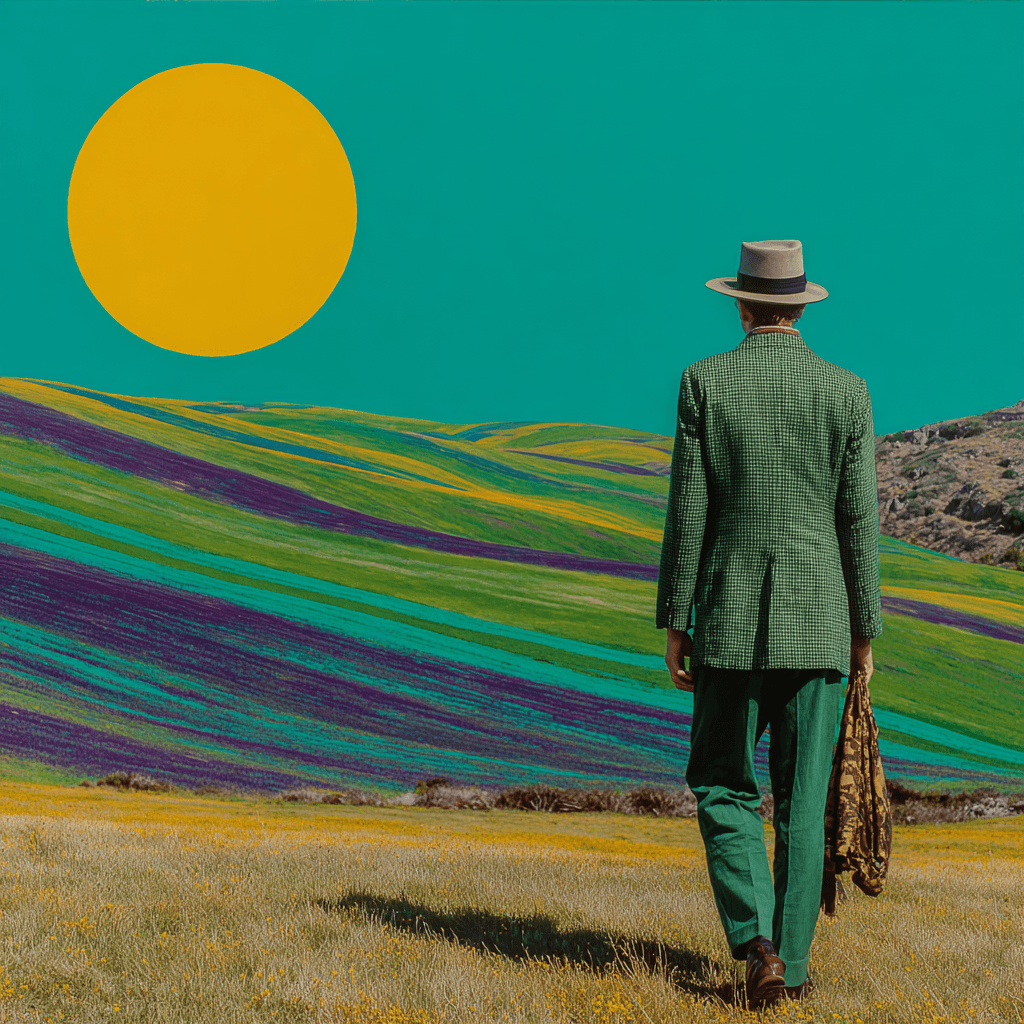
There is a method, documented among hunters in parts of Central Africa, for trapping a baboon without force. Imagine you are stranded and in need of water. You find a termite mound, or carve a hole in a log, and you fill it with salt. The baboon comes to investigate. It reaches in, closes its fist around what it finds. The fist, now clenched, is too large to extract through the opening. The baboon's nature will not let go. It will stand there, fist in the hole, as you approach at a walk. It will panic, pull, strain — and yet hold on.
But the more sophisticated version of the trap doesn't stop there. Once you have the baboon, you give it salt in abundance. All it could want. The baboon eats, and eats, and begins to suffer the thing salt does to a body taken past satiation: it dehydrates. It needs water. And because the baboon knows where water is — instinctively, the way every creature knows what it needs to survive — you simply release it and follow. It will lead you there itself.
I. The Three Parts of You
Plato, writing the Republic around 375 BCE, proposed that the human soul contains three distinct and often competing parts. He called them Logistikon (reason), Thymoeides (spirit or will), and Epithymetikon (appetite or desire).
Reason seeks truth. It is patient, long-sighted, capable of deferring pleasure in the service of understanding. It asks not "what do I want right now?" but "what is actually good?" Spirit seeks honor — recognition, victory, the sense of being seen as worthy. It is the part of you that responds to injustice with outrage, that would rather die than be humiliated, that drives you to compete and protect. Appetite seeks pleasure. Food, comfort, sex, money, sensation — not wrongly, Plato is careful to note — these are not evil desires, rather they are necessary ones. The physical body requires them. The problem is not that appetite exists, it is what happens when it governs.
A just soul, in Plato's architecture, is one in which reason leads, spirit enforces reason's judgments, and appetite is satisfied but not in charge. This is a hierarchy of balance, in which each aspect is honored where it belongs — producing tranquility, rather than suppressing any part of the human. The philosopher who fasts to think more clearly is not denying the body; they are reinforcing who is in command of the decision.
Now apply this framework to a society. Plato does exactly this — the Republic is built on the premise that a city is the soul writ large. A city governed by reason produces wisdom and philosophy. A city governed by spirit produces honor-culture, military valor, the warrior aristocracy. A city governed by appetite produces commerce, competition, and the perpetual desire for commodities. And a city whose appetite has become ungovernable — whose unnecessary desires have been encouraged until they cannot be denied — produces tyranny.
The tyrant, in Plato's analysis, is not simply a cruel person. The tyrant is the person most enslaved to appetite — enslaved so completely that they can no longer distinguish between what they want and what is good. Every resource of the city must be redirected to feed a desire. Every person of spirit must be eliminated, because spirit — honor, courage, the refusal to be humiliated — is the one thing that threatens them. Every voice of reason must be silenced, because reason is the one faculty capable of exposing the lie that obscures a leader's responsibility to the commonwealth.
In Book I of the Republic, before the argument about the ideal city even begins, Socrates encounters a man named Thrasymachus, who declares that justice is simply "whatever is in the interest of the stronger." He is aggressive about it, contemptuous, even. When Socrates begins to examine the claim, Thrasymachus does not engage — he demonstrates outrage at the examination itself. Socrates, with patience that reads across two and a half millennia as something very close to grief, observes the problem: you cannot reason with someone who has decided before the argument begins, just as you cannot use logic to shift a conclusion that was not reached by evidence. The dialogue proceeds anyway, because the others in the room are genuinely asking. Plato notes, almost as a caveat, that none of what follows will be satisfying to someone who refuses to inquire — a structural fact about how minds work when appetite has learned to impersonate certainty.
II. The Allegory of the Cave
You probably know the allegory. Prisoners chained in a cave watching shadows projected on a wall by figures passing in front of a fire behind them. The shadows are all they have ever seen. The prisoners can name them, catalog them, build expertise in predicting their movements, mistaking the shadow for the occluding object.
The philosopher, in Plato's telling, is the prisoner who turns around and sees the fire. Who is dragged, reluctantly and painfully, out of the cave into daylight — and who, after the blindness clears, sees the world as it is rather than as it appears. The philosopher then returns to the cave to tell the others. The others, whose eyes have adjusted to darkness, find the returning philosopher's claims absurd, preferring the comfortability and stability of the shadows. The shadows make sense to them.
In 2026, the cave has a refresh rate of 60 frames per second and an algorithm optimizing for the emotion most likely to keep you seated. The shadows have brand partnerships and are tailored for marketability. This is not metaphor deployed for effect. The attention economy — the system by which human consciousness is packaged and sold as inventory to advertisers — is architecturally identical to Plato's cave, requiring not your assent, but mere presence. The prisoner does not choose to watch the shadows; the chains do that. Just as you did not choose to spend four hours in a notification loop; the variable reward schedule did that. This mechanism is not new — the Romans even coined the phrase, panem et circenses, meaning bread and circuses. What is new is its precision.
The philosopher's return to the cave is what Divine Ipseity is attempting. Not from above — there is no above, and the anonymous voice of this project is a choice, not a modesty — but from beside. We are also in the cave, learning to turn around and report what we see.
III. The Trap, Revisited
The first layer is obvious: capitalism offers commodities, you reach for them and your hand swells. You cannot withdraw without losing what you've grasped: the car you financed, the apartment you abide in based on a subscription model, the house on a mortgage that makes it so that you cannot afford to quit. This is the financial architecture that ensures the cost of survival is calibrated just above what a single person can save. You cannot let go because letting go means losing the small amount you have already secured. The trap does not require a hunter — it is self-enforcing.
The second layer is subtler. Once you are in the trap, you are given more salt: consumer culture, celebrities, dopamine. It keeps you satiated enough for conformity and always looking at the next thing. The middle class dream — which was, as we'll establish, a deliberately engineered category — promises that if you work hard enough and don't cause too much trouble, you too can have abundance. The hand stays in the hole because there is always more salt coming. The dehydration is gradual; you do not notice it as thirst, but as a vague sense that nothing is enough — that the thing you worked for did not deliver what it promised, and maybe the next one might.
The third layer is where the trap earns its sophistication. The dehydrated baboon leads you to water.
Your appetite, once engaged and then frustrated, activates something deeper: the generative parts of the soul that Plato called spirit and will — the parts that produce art, innovation, meaning, connection, philosophy. The capitalist system does not only extract your labor, it extracts your creativity, your community-building, your meaning-making, and sells it back to you at a price. The musician who records an album from genuine suffering signs to a label that owns the master recordings. The teacher who genuinely loves students works in a system where they wonder if they'll have enough supplies for the year and measures their contribution in test scores. The writer who reaches something profound publishes through a platform that takes seventy percent and knows more about their audience than they do.
There is a concession to be made, though. Capitalism has brought humanity farther than any other system in history by almost every observable metric available. When someone says capitalism breeds innovation, they aren't very far off from the truth. Capitalism breeds the innovation of capital; new ways to use, trade and allocate money is evidently very prosperous, but what is apparent is its propensity to value capital over humanity. The accumulation of capital is not evil in the way that a person is evil. It is indifferent in the way that a river is indifferent to the valley it carves. Capital aggregates because that is what the rules of the system cause it to do — interest compounds, ownership multiplies, the person with more can buy more of the mechanisms that produce more. There is no malice nor conspiracy required. The trap is structural, apathetic; the hunter does hunt out of hatred but out of desire.
This distinction matters because it locates the problem correctly. The problem is not the wealthy individual who must be punished. The problem is the system that makes wealth self-replicating regardless of the contribution of the wealthy person to the common good. Peter Turchin, in Ages of Discord (2023), documents the historical pattern: when elite wealth concentrates past a certain ratio to median wages, social instability follows — not because the poor revolt out of envy, but because the structural conditions of broad participation in the economy collapse. Turchin calls this "elite overproduction" — too many people competing for too few positions of power, with the excess becoming the political entrepreneurs of instability. You do not need to believe in Turchin's specific model to recognize the shape of the current moment in it.
IV. The Present Tense of Tyranny
Plato describes the tyrannical city as one where the leader must continuously manufacture enemies — foreign and domestic — because fear is the only substitute for the loyalty that only a just leader earns. The tyrant cannot afford peace because it allows reflection, and that allows the prisoner a moment to inspect the chains. You do not need a taxonomy of current political figures to recognize this mechanism, but there is no shortage of examples. It is the mechanism of every government that has discovered, in any era, that a population afraid of an external threat is less likely to examine an internal one. This logic transcends the test of antiquity.
What is particular to the present is the role of media illiteracy and social media in sustaining the tyrannical arrangement. Plato's cave prisoners had one screen. We have 90,000,000 of them, and each one is curated by an algorithm that has learned, with extraordinary precision, that outrage retains attention longer than analysis. The prisoner who has learned to feel outrage on cue — to experience the shadows as a continuous emergency — is the prisoner least likely to turn around. The emotion may be real, but the direction is orchestrated.
The distrust in community that follows is the arrangement's intended output. A population that cannot trust its neighbors — that has been trained to see difference as threat, to interpret community organizing as ideology, to regard solidarity as naive — is a population that cannot coordinate against the system extracting from it. The baboon, isolated, stays in the hole; the baboon with other baboons watching might be pulled free.
The conservative pushes of this political moment — the hostility to public education, the dismantling of regulatory frameworks, the attack on institutions that aggregate knowledge — are legible as policy choices in favor of appetite and against reason. Not because the people enacting them are irrational, but because their interests are served by a population that is, and have been manufactured to be so. The philosophy student who becomes a legendary philosopher threatens the oligarch. The factory worker who learns economics threatens the factory owner. Knowledge, organized and distributed, is the one resource that does not become scarcer as more people have it, which is why truthful information is the first thing controlled in every tyrannical arrangement.
V. "When Has It Ever Worked?"
There is an objection that will arrive here, and we should meet it rather than walk around it.
Communism has been tried and it produced the Soviet Union. Socialism has been tried and it produces stagnation. The alternatives to capitalism have failed. At least capitalism produces innovation. At least it produces something.
This is the Thrasymachus objection in its most reasonable form, and it deserves a reasonable answer.
Every economic system that has ever existed has been implemented by human beings operating under specific historical conditions, with specific distributions of power, in specific material circumstances. The Soviet Union was not communism in the way that Marx theorized it — it was a revolutionary vanguard that became an autocratic state, capturing the language of workers' liberation while reproducing the power structure of the Tsar. This is not a defense of Soviet communism; it is a refusal to let the worst implementation of an idea stand as the definitive refutation of the idea itself.
The relevant question is not "has a just society ever been fully achieved?" — it has not; nor has perfect health, nor has any other aspiration toward the good. The relevant question is "what prevents just arrangements from taking root?" The answer, historically, is the same force that prevents them now: the organized resistance of those whose accumulated advantage depends on the current arrangement remaining in place. This is what is meant by "complex agency" — the recognition that outcomes are not simply the product of ideas but of the power dynamics that determine which ideas get implemented, in what form, for whose benefit. The failure of every socialist experiment is not evidence that equality is impossible, rather it is evidence that equality is fiercely opposed by those with the most to lose from it. Saying "it has never worked" as though that settles the question is like saying "medicine has never eliminated all disease" as though that means we should stop trying to cure anything.
This reasoning will not satisfy everyone. It will not satisfy the person who has decided, before the argument begins, that the existing order is natural rather than chosen. We are not writing for that person right now — not because they do not matter, but because the Republic teaches us that some arguments can only begin with willing inquiry. If you are reading this and finding it worth examining, you are already turning around.
VI. The Goal: Toward Individual Aristocracy
Divine Ipseity's mission — the preservation of human beings against systems that subordinate them — does not call for the overthrow of capitalism by force or the installation of any historical alternative. History's solutions were made for history's conditions. We are not nostalgic.
What the brand calls for is more demanding than any political program, and more tractable than utopia: the development of the aristocratic soul, in Plato's sense, within the context of a world that is actively organized against it. The aristocratic soul is not a class designation but a disposition of governance — the condition in which reason, rather than appetite, determines the direction of a life. The person who has achieved this is not cold or joyless. They eat, love, feel — but they are not led by these things. They can examine a commodity and ask: does this serve me, or have I been engineered to reach for it? They can encounter a political spectacle and ask: whose interests does this fear serve? They can look at their own exhaustion and ask: is this my own, or was it given to me?
This is what "divine ipseity" means — selfhood in the full philosophical sense: being the author of one's own soul. Ibn Arabi, the 12th-century Andalusian mystic whose thinking gives this project its name, described al-ipseity as the essential selfhood that precedes and exceeds any role, category, or system imposed on it. The self that cannot be fully colonized because it is more fundamental than the colony. The aspiration to individual aristocracy — to sovereignty of soul — is not sufficient on its own. Plato makes this point insistently: the philosopher who reaches the light outside the cave has an obligation to return. A just person living in an unjust city is still living in an unjust city. The internal work and the communal work are not alternatives. They are the same project, approached from different directions.
This is the uncomfortable concession: the commonwealth we are describing has not existed. It will not be installed by a single election, a single movement, or a single essay. What we can do is increase the number of people who see clearly enough to begin — and trust that clarity, distributed, becomes something no single system can entirely contain. We consent to our own diminishment for as long as we mistake the arrangement for the world. The work is to stop mistaking it.